Georgia‘Asureti’s German heritage is our treasure’ — how a Georgian village is preserving its past
by Mikheil Gvadzabia
(Updated: about 1 hour ago)Asureti’s German settlers were deported by the Soviet regime in the 1940s, but their heritage continues to shape the village.
‘Here is our Frida’, 86-year-old Otar Tsereteli, a resident of the southeastern Georgian Asureti village, tells OC Media, pointing to the gravestone of Frida Azariashvili, a local tailor who died in 1985 at the age of 72.
‘Frida’s daughters studied with me at school. We sat in the same class. I remember Frida, she was a very good woman’, Otar says, recalling one of the last fully German residents of the village.
Frida was born in Asureti, then known as Elisabethal, in 1912. Germans from the historic region of Swabia in southwestern Germany had already been living there for nearly a century.
The first Swabian German families migrated to present-day Georgia in 1817, at the invitation of the Russian Empire. They had plenty of reasons to leave their original homeland, from socioeconomic hardship, to state persecution of non–mainstream religious groups inside the Evangelical Lutheran Church. Traveling thousands of kilometres in search of a new home, they built thriving settlements on lands granted by the empire, including Elisabethal.
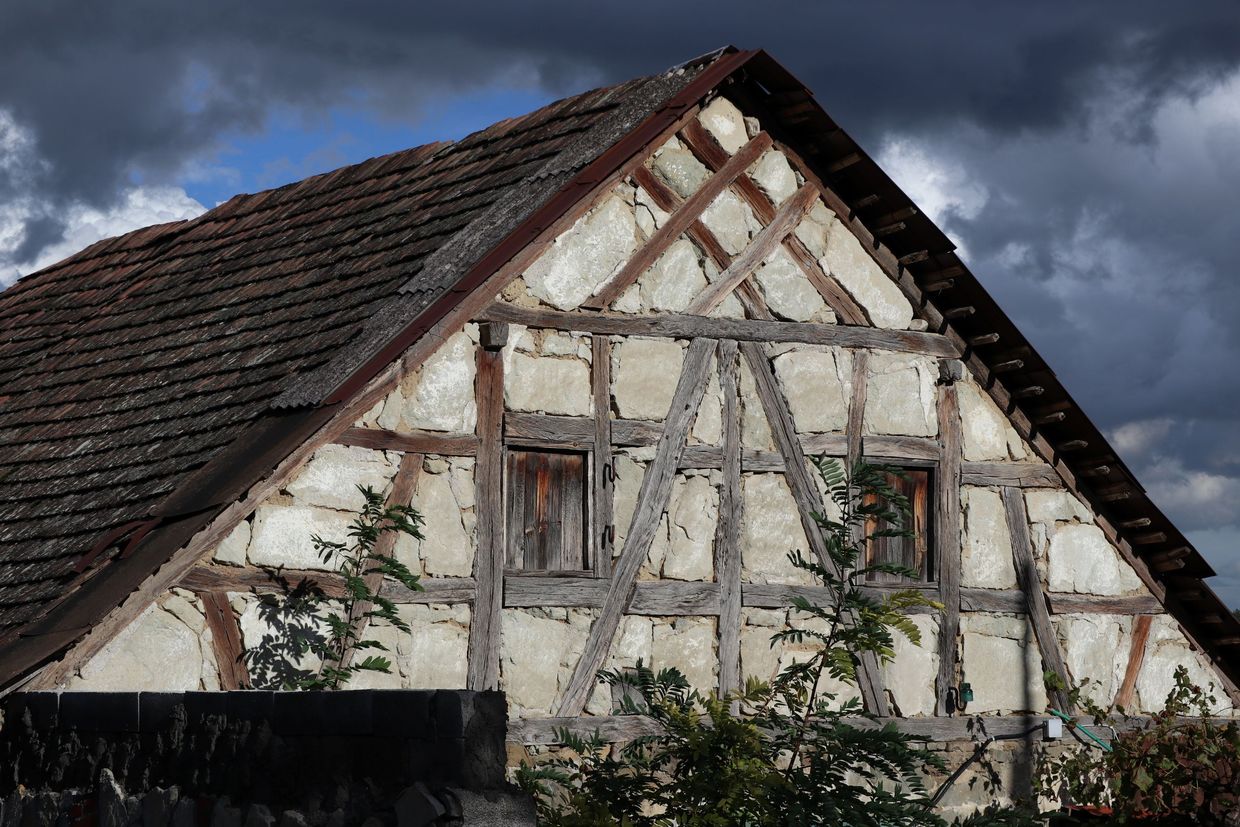
Nestan Tatarashvili, an architect who has spent years researching German heritage in Georgia, says that Elisabethal was particularly well-suited to winemaking and agriculture, as well as livestock farming. Assessing the village for its architectural value, Nestan calls it ‘one of the best’, with a well-planned layout, an Evangelical Lutheran church still standing in its centre, traditional German rural houses and a German section of the cemetery with numerous well-preserved gravestones dating from the 19th and early 20th centuries.
‘They had a very strong unity, a shared fund, and were highly organised, both in their work and leisure’, Tatarashvili says, adding that the village retained its prestige after the establishment of Soviet rule, until the authorities forcibly emptied it of its German population.
Shortly after Nazi Germany’s invasion of the Soviet Union, more than 40,000 ethnic Germans — including over 20,000 from what was then the Georgian Soviet Socialist Republic (SSR) — were deported from the Caucasus to Kazakhstan, leaving behind their homes, gardens, vineyards, and the rich history they and their ancestors had built there.
Yet a few managed to stay, most of them women, all thanks to the nature of their marriages.
‘We thought it was temporary’
Frida’s Georgian surname, and the fact that her gravestone is inscribed in Georgian, are not coincidental. Born Schmidt, Frida was among the local women who married Georgian men from nearby settlements. Her husband Mikheil (Misha) Azariashvili’s parents worked on her family’s estate.
‘My mother’s parents, Germans in general, were very hardworking people and owned a lot of land. They always had people from outside the village working for them’, Frida and Mikheil’s daughter, 85-year-old Natela Laishvili, tells OC Media. Natela still lives in her mother’s family house in Asureti. Her twin sister Luiza died from an illness in 2023.
‘His parents told him, “Misha, if you want to start a real family and have a good life, marry Frida”. Then they probably met a few times, and that’s how my mother ended up marrying my father’, she adds.
It was these mixed marriages that ultimately saved a small number of German women from mass deportation in the 1940s.
According to Natela, when Frida’s parents learned they were being deported, her grandfather went to Tbilisi, where Frida had moved with her husband, and brought her and her twin daughters back to the village so that the property would not be left unattended. The twins were just over a year old at the time.
‘We thought it was temporary’, Natela recalls Frida later telling her. But the situation proved permanent. Frida’s husband, Mikheil, was drafted and died in the war, leaving his wife alone with their children. Her parents, sister Lida, and brother Otto were deported to Kazakhstan.
By the war’s conclusion, besides Frida and a few other German women with non-German husbands, hardly any of the original inhabitants remained. At the same time, people from western Georgia’s Racha region were settled in their former homes.
Despite now being thousands of kilometres apart, Frida’s family managed to stay in touch, first with letters and later through visits: Frida, together with the twins, travelled to Kazakhstan to see her parents and siblings, while some of the latter visited Asureti more regularly.
‘When a letter arrived from Kazakhstan, she would read it aloud, and we could understand it because we knew German. She would read it in Swabian’, Natela recalls.
She says she remembers only a little German now, but it was once the other way around.
‘My mother was told to speak Georgian to us so that we would learn it well enough to be able to study at school’, she notes.
Although separated from her family, Frida kept their German traditions alive. Natela still remembers the German dishes her mother prepared for her and Luiza, as well as the cakes she shared with neighbours.
‘My mother’s family were very religious. My mother was the same. We would sit down to eat, and she would first mumble a prayer [in German], then serve us the food’.
Natela also remembers Sunday gatherings — the way Frida and the few other German women kept their community alive.
‘One Sunday we would gather at one family’s house, the next Sunday at another’s […] They would laugh, tell old stories, and stay in touch this way’, she recalls, mentioning other women by their names: Ella, Tina, Paulina and Erna.
Changing demographics
Beyond her family, Frida’s memory is kept alive by other elderly villagers, including Otar.
Otar was nine months old when his family was relocated from Sadmeli — a village in mountainous Racha — into a house that had until recently been occupied by a German family. He recalls that while some Racha residents agreed to relocate because of the difficult conditions in the mountain villages and Asureti’s proximity to Tbilisi, local Communist officials interfered to persuade others.
‘At the time, everyone overseeing this [process] had been selected from among the old Communists, party workers. My father was also a member of the [local] party committee’, Otar says.
The deportations of Germans took place mainly in the autumn of 1941, with reported fatalities from the cold and harsh conditions during transport. Otar recalls that the journey was not easy for those relocated from Racha either, saying many children died from the cold.
‘There were cannons and other military equipment being transported by [rail]. The war was ongoing, the railway had no time for us. The train would stop for a day, sometimes two. It was cold, they caught pneumonia, and they died’.
In the mid-1950s, deported Germans were formally rehabilitated, but not given the right to return. Nevertheless, according to Tatarashvili, a small group of deportees from the Azerbaijani SSR managed to return, establishing a settlement in Georgia’s Gardabani Municipality.
Among them was a deportee from what was then Otar’s house, who had since married another German deported from Azerbaijan. Otar says the woman visited her former home in the late 1970s or early 1980s. He welcomed her, showed her around, and helped restore her pension in the Georgian SSR.
‘I told her to come and stay whenever she wanted during vacation. She was born and raised here, and her family had lived here for two centuries. I treated her as a host should, with the respect’, he says.
Natela and Otar both describe Georgian-German relations in the village as very positive, with Otar saying that ‘you won’t find a man in the village who speaks ill of them’.
‘We had a good relationship, and everyone respected my mother’, Natela re